


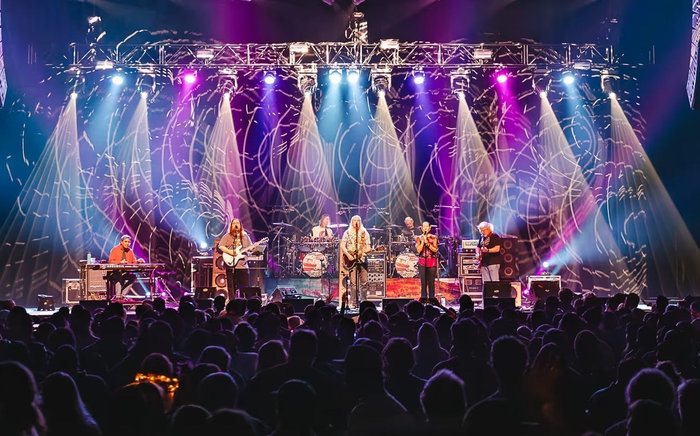
July 31st and August 1st, 2026, the fantastic Dark Star Orchestra (DSO) will play two shows at the Greek Theater in Berkeley. Proceeds will benefit the Rex Foundation, the nonprofit founded by members of the Grateful Dead and ‘Friends’ in 1983.
Since forming in 1997, DSO has performed over 3,400 shows, recreating legendary Grateful Dead shows and the creative musical spirit that was their hallmark. Going forward, these shows will be more than just a tribute to Dead shows of the past; they will also serve as a critical nexus for Deadheads of all stripes (new heads and longtime diehards) to tap into the indefinable and spontaneous sense of community that was the magic of a Grateful Dead show.
The August 2025 trio of Dead & Company shows at Golden Gate Park (which celebrated the 60th Anniversary of the Grateful Dead) and the subsequent recent passing of Grateful Dead founding member Bob Weir signaled the end of an era in the jam band ecosystem. With that, there is a “passing of the torch” happening as the scene as a whole is now treading uncharted waters. As such, the role that DSO plays in that scene has grown and expanded in ways they probably never imagined.
Rob Barraco (longtime keyboardist for DSO – since 2005), was kind enough to sit down with SFSonic for a few minutes to talk about his unique musical journey, how he was introduced into the Grateful Dead universe, how DSO fits in, and the upcoming Greek Theater shows paying tribute to Bob Weir. Here’s a taste of what was discussed….
SFSonic: Hello Rob. Very nice to meet you. Thanks for taking some time to speak with SFSonic.
Rob Barraco: Oh, thank you. Nice to meet you.
SFSonic: Before we get into discussing Dark Star Orchestra (DSO) and the upcoming Greek Theater shows at the end of the July/start of August, we wanted to get to know a bit about your musical journey. I understand you started playing music at a very early age. What got you into music so young and what were your influences….who were you into initially?
Rob Barraco: It’s all my parents’ fault. They were avid music listeners. There was always music on in my house…morning, noon, and night. They were into big bands and Sinatra. So I was hearing hints of jazz in all of this music. And they would try to be hip so they had rock records from the 50’s and 60s and that interested me as a very small child.
Then when I was six years old The Beatles played the Ed Sullivan show, and I knew right then and there that was what I was going to do with my life. I told my mom “I want to be him”, and I pointed to John Lennon.
About a week later she handed me an acoustic guitar and she made me take lessons, and that started the journey. Then I became a total Beatles freak….i didn’t want to hear anything else…Beatles, Beatles, Beatles.
Slowly over time I started hearing other music and when I was 14 I first became aware of the Grateful Dead and that really blew the doors off the whole thing.
SFSonic: With regards to your instrument of choice, what crossed you over from guitar to keyboards?
Rob Barraco: I played guitar for about five years, and I had a great teacher. And he was integrating jazz theory into what he was teaching without me even knowing it. He was a genius, and he knew nothing about the Beatles, he was a ‘jazzer’, but he went out of his way to learn their tunes and teach them to me.
But in the manner that he taught, he taught the structure of what was happening…the way they were writing the songs and the chord progressions. How important melodies were.
So when I got turned on to the Grateful Dead at 14, and I’ll answer your question in a minute, I got attracted to the Dead right away because of the melodies of their tunes. But it wasn’t until I first saw them live when I was 15 that I realized about the improv thing and that they were just basically flying by the seat of their pants every night.
Now when I was about 11 years old I got bored with the guitar…I can’t even remember why. But at this time my parents had a huge blow out because my mother wanted a piano in the house and my dad wanted a theater organ. My dad won the argument and a theater organ appeared. so I started taking lessons and really grew to love it.
I learned all the stuff my parents liked, and all the Beatles tunes, and then I got introduced to the blues and started taking off on the blues just before I saw the Dead for the first time. Keith Godchaux was their piano player. When I heard him play, and the way he integrated himself in between Jerry and Phil I was blown away.
So there was a seed planted by him, and when I went to college I was a classical organ major and I switched to piano. And I started to listen to all the jazz piano players…McCoy Tyner, Bud Powell, Chick Corea, Herbie Hancock, etc.
So that’s how I transitioned out of guitar and into keyboard, and eventually only to piano. For many years I only played piano, and now with Dark Star and the other Dead bands that I have played in with Phil and the Dead themselves, I have played multiple keyboards…piano, organ, synth.
SFSonic: You’ve had a very eclectic musical journey since discovering the Grateful Dead in your teens. You were involved in the Cosby Show band and also played with R&B/soul singer Freddie Jackson. How was that for you and how did you ultimately get switched back into the lane of the Dead?
Rob Barraco: In the early 80’s I considered myself a budding jazz musician and that is where my focus was. I was playing in a New York band called Eclipse with a guitar player named Bob Gallo who was an absolute genius composer and player.
We were in the studio recording and there was a gentleman in the room just sitting there, and he said “Man, you guys are really good. Would you consider doing some TV work?”. And we’re like sure what kind of TV work? He said he was the music director for the Cosby Show.
Now the Cosby Show wasn’t even through with their first season when this happened. I read an article about the musicians they were using and they were all LA studio guys. I asked him “What about all the cats in LA?”
He said they film the show in New York and want to move the entire operation to New York. So that’s how I got connected to the show and we were on the show for the rest of the run. Then they started A Different World, the spinoff show, and I got to do that for five years.
From there I got connected to the music director for Freddie Jackson, and he said they were getting ready to go off on a summer tour and needed a keyboard player….would I be interested?
I said yeah, but I really don’t know the music. So he sent me some CDs in the mail and I listened and thought I can definitely do this. It was definitely different but ended up being my first big road tour. It was fabulous…I had a great time. I was in the band for two years and I saw the trajectory of my career going in a different direction.
I then got approached by a gentleman named Jeff Mattson who is Dark Star’s lead guitar player now. I knew Jeff from the Long Island Dead scene. He asked me if I would be interested in joining the band Zen Tricksters. I was like “I don’t know. I have all this other stuff going on.”
He asked me to come down and jam with them. So I went and sat in with them and it was really cool playing a bunch of their original tunes. He asked if I write, and I told him I had a ton of stuff, and I played it for him. It was then that I realized I needed to get back on that track doing improv.
With Freddie Jackson we were playing note for note every night for two years. So that’s how I got back into the Dead scene.
SFSonic: After the experience with Freddie Jackson and getting in touch with Jeff you now had it in mind that you wanted to get back into the jam band scene. How did you eventually get connected with Phil Lesh to get into Phil and Friends?
Rob Barraco: The Zen Tricksters was a band that was around for a long time. I played keyboards with them for about 11 years. During that time we recorded two CDs. For the second CD I called up this guy that I knew who was a writer for Relix Magazine named JC Duanas.
I knew that he was on a friendly basis with Phil Lesh, so I sent him two copies of the CD. One for him to review for the magazine, and for the second, I asked him if he could send it to Phil. I told him I would love to get some feedback from him.
SFSonic: That must have been mind blowing for you to go from getting introduced to the music of the Grateful Dead at 14 to now connecting with and eventually working with their bass player Phil Lesh.
Rob Barraco: Well many months went by and I heard nothing. I was in San Francisco playing a show with the Zen Tricksters. JC Duanas came to our show. I asked him if he ever got the CD to Phil and he said he did but he hadn’t yet heard anything back. I was so disappointed.
The next morning we got up to go to Oregon for our next show. On the way we stopped off at a gas station, and this was before we all had cell phones so we were calling in to get messages. At the time I lived with Jeff Mattson and he called home, then he gave me this crazy look and said “You won’t believe who left us a message on our phone…Phil Lesh. He said on the message that he wants to play with me and you.”
I thought there was no way. So he calls back the number and sure enough Phil answers. Apparently they were moving offices and our CD got lost in the shuffle, and Phil’s right hand man was a big fan of the Zen Tricksters and he found the CD and put it on top of a pile of music that Phil was listening to. It just so happened that he was actively looking for musicians to play with, and he heard the CD and freaked said I want to play with these guys.
So that was my introduction to Phil. I ended up going to rehearsals with Phil and he took me aside and said “You and Jeff are going to play these shows at the Warfield with me but I’m leaving right after that to go on my first national tour with my own band, and I would love for you to be the keyboard player.”
That band was amazing. It was with Warren Haynes and Derek Trucks, me, Phil, and John Molo. To make it even more intimidating we were co-billing the tour with Bob Dylan.
From there I knew I needed to progress and move on from what I had been doing. I wanted to play with Phil and so I made the decision to leave the Zen Tricksters. I told Phil, and a couple of weeks later he called and said he was starting a permanent new band and wanted me to be a part of it. That band was the Phil Lesh Quintet (known as ‘The Q’).
Phil was an amazing mentor and was like a second father to me.
From there I got to play with The Other Ones and through Phil I got to meet Chris Robinson. When I was out of The Dead by 2004, all the sudden Chris Robinson called me and said I’d like to play with you if you are into joining my band. So I did a couple of tours with him.
Right after that I got a call from Dark Star Orchestra’s manager. Their keyboard player Scott Larned had unexpectedly passed away on the road in 2005 and that was my beginning with Dark Star and it continues 21 years later.
SFSonic: Through that winding musical journey, who was the coolest person you got to work with?
Rob Barraco: Actually Phil was the coolest…no doubting that. But one of the coolest things that happened was with Warren Haynes. He was in the Allman Brothers the whole time we were in The Q together, and one day we were hanging out on tour. It was March of 2001 I think, and Warren called me and said “What are you doing tonight?” I told him I had no plans and he said “Why don’t you come out to the city and sit in with the Allman Brothers?”
So I took a train to the city and went to the Beacon Theater and met with the Allman Brothers. They announced me and I came onstage and sat on Gregg Allman’s organ bench with him on organ to my right and me on his piano on his left. I ended up playing quite a few shows with them, but yeah, Gregg Allman was the coolest cat. Just the nicest soul and you could feel it.
SFSonic: Being with DSO for such a long stretch now, and especially with the recent passing of Bob Weir, how has that changed the scene and where do you see it going?
Rob Barraco: There is a very palpable thing that is going on since Bob passed. A lot of people are coming out to the shows. More people than ever. Because I think people realize that this is a very fragile and beautiful thing, the Dead community, and everybody wants this thing to live on. And the only way for it to live on is to participate in it. And they are.
They’re participating and coming out. In a way I think some people are still grieving. I have many friends that are still just blown away that Bob passed away. Even more than Phil and maybe even Jerry for whatever reason.
Bob said before he passed that the seeds of the Grateful Dead are going to go on for 300 years and I believe it. The music is strong enough and the community is strong enough, and the community supports one another and that’s a beautiful thing.
SFSonic: Given all the change in the scene and Bob Weir’s passing does that put a little bit more purpose and fire into the shows coming up at the Greek?
Rob Barraco: Absolutely. The Rex benefit shows will be a tribute to Bob with some special guests coming down who all were associated with Bob. It will be an all-star cast of musicians sitting in.
Bob loved the Greek and playing there so these will be very special shows and it gladdens our hearts very much to be able to honor him.
And Jerry’s birthday is always a holiday. And to play an iconic birthday show of his which back in the day I had a tape of and loved every second of it. I’m thrilled to death to be able to recreate the show for the masses. We’re going to give everything we have and more at those shows and are super excited to be doing them.
SFSonic: Thanks for the time Rob. See you at the Greek.
So there you have it from the mind and mouth of Rob Barraco of Dark Star Orchestra.
By the way, the show that Rob referenced for Jerry’s birthday show on August 1st, will be the DSO re-creation of the Grateful Dead’s August 1st, 1973 Roosevelt Stadium show in full, which was the first time the Dead performed on Jerry’s birthday.
Photo by Courtney Scout
Type your paragraph here
