


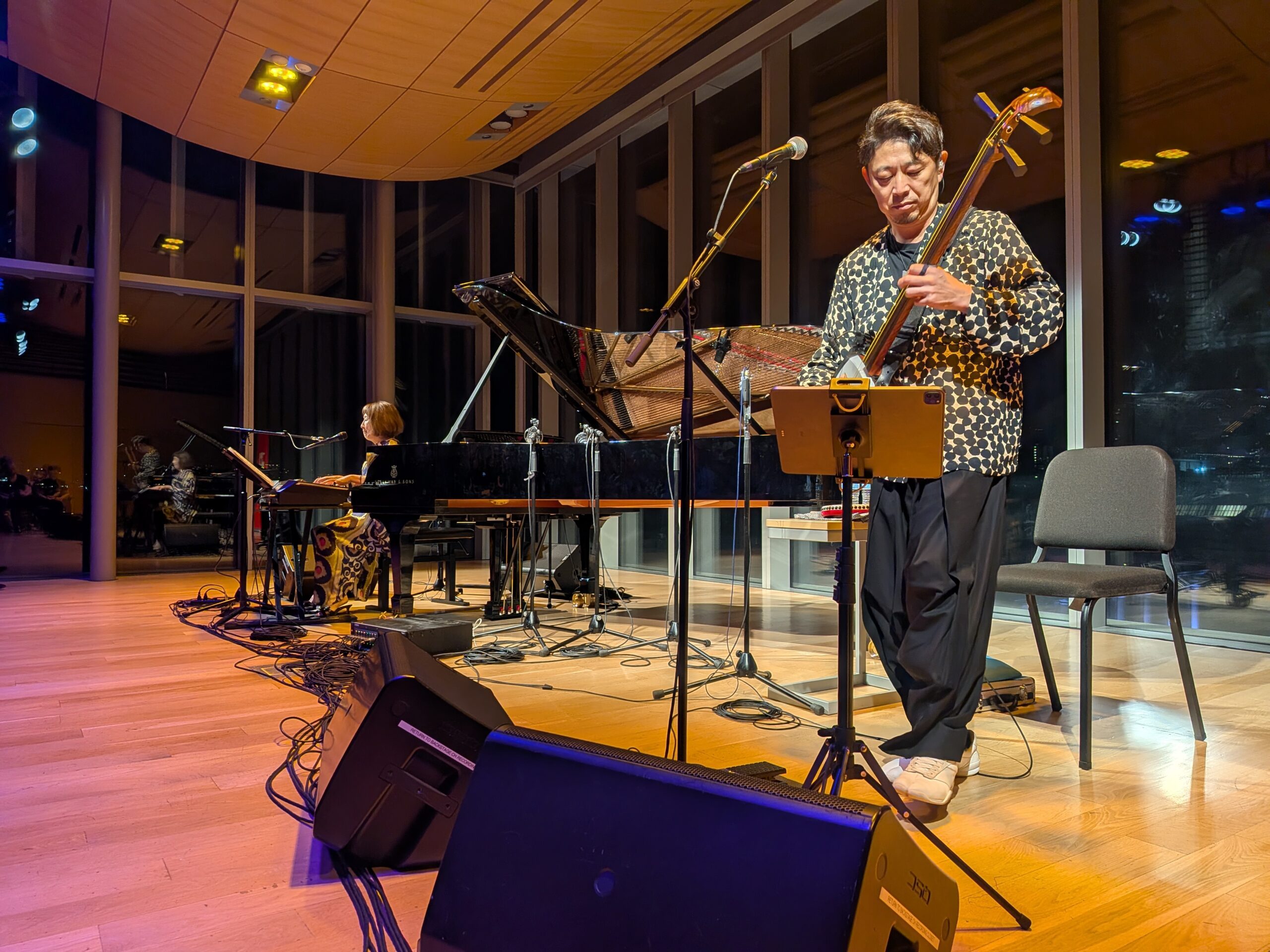
Yano et Agatsuma
Barbro Osher Hall
September 14, 2026
Photos by Tyler King
Beginning in September, the Japan Society of Northern California has begun a new concert series titled Arts from Japan, which will see some of the most esteemed musicians from that country performing throughout the Bay Area. The inaugural concert of the series saw the return of Akiko Yano to San Francisco, joined by Tsugaru-shamisen player Hiromitsu Agatsuma. As someone who has literally flown across the country to see Akiko Yano before, I knew that this was a special show that could not be missed.
The performance was held at the Barbro Osher Hall on the 11th floor of the Bowes Center, and as the sun began to set and turn the sky a dark pink, Yano and Agatsuma emerged from the halls, Yano sitting behind a grand piano and Agatsuma picking up his Tsugaru-shamisen.
What followed was a performance that drew heavily from the duo’s 2020 album Asteroid and Butterfly, a record that saw the two reinterpreting various Japanese folk songs. Akiko Yano has a history of reinterpreting not just standards by groups such as The Beatles and The Rascals, but also of her own music and that of Yellow Magic Orchestra, a band she was a live member in throughout the late ’70s and early ’80s. With such an extensive background of reimagining music from all across the globe, it should come as no surprise that the songs she and Hiromitsu Agatsuma performed sounded like they could have been originally written by the two of them.
Akiko sat behind the grand piano for most of the performance, sometimes shifting her seat to play the keyboard set up next to it, such as on the song “Tankai-bushi,” which saw Hiromitsu taking on lead vocal duties while playing the Tsugaru-shamisen. The two, initially brought together at a performance held by the New York Japan Society some years ago, perform in perfect harmony with each other, watching each other’s face and body language for cues as to where the songs they’re playing will go. There are no setlists on the stage, only sheet music sitting atop the piano that Akiko sometimes flipped through. To watch Akiko Yano and Hiromitsu Agatsuma play music together is to watch two of the best artists of their respective craft creating something completely unique and transcendent.

There was a section during the show where Agatsuma left the stage, and Yano performed two songs from her extensive solo catalogue by herself. The first was a song from her new album, To The Living Creatures, titled “You Are Special to Me.” I knew going into the show that there would be a strong focus on songs from the Yano et Agatsuma album, so to see Akiko play something from her brand new album was a complete surprise. The song showcases that even after recording music for 50 years, Akiko Yano can still create amazing work. After that was her staple, “Ramen Tabetai,” performed in a stripped-back manner that saw the audience laughing to her plea that it was time for ramen.
Once the song ended, Akiko left the stage and Hiromitsu sat down to perform two of his own songs on just the Tsugaru-shamisen. As someone who is mostly unfamiliar with the instrument, I was blown away. Despite being instrumental songs that were played on a single instrument, I felt like Hiromitsu Agatsuma was taking me on a journey as the songs progressed. Both felt long but somehow confined, with multiple points of tension and release. I looked around the hall at various points during the songs and saw that most of the front row had huge smiles on their faces watching Agatsuma’s hands expertly plucking and fretting the three-stringed instrument. It was enough to make me want to continue exploring his solo work.
Akiko came back to the stage for the second half of the performance, and soon the two played a song that I had been hoping for, which was their version of Akiko’s 1980 song “Rose Garden” from her album Tadaima. Although the original is full of synthesizers and electronics, the two have been able to strip it down to its core and reimagine it in a way that makes it sound fresh and new, even more than 45 years after it was first released. I found myself stomping my foot to the tempo of the song, and the performance was definitely the highlight of the entire evening for me.
After the main set came to a close, Yano et Agatsuma returned to play two more songs. The show ended with a performance of a song written by the two of them, “Funamachi-uta Part III.” The song serves as a sequel to the first two parts of the song, both found on Yano’s 1976 debut album Japanese Girl. It was a rousing way to cap off the evening, ending with Akiko and Hiromitsu leading the crowd in a sing-along of the closing lines of the song. With one final look between the two of them, Yano et Agatsuma ended the song, took to standing before their instruments, bowed together, and walked out of the hall to a rapturous applause.
The Barbro Osher Hall is one of the smallest venues I’ve seen a show at, but also one of the loveliest. I truly had no idea what to expect when I got off the elevator onto the 11th floor of the Bowes Center, but after taking my seat, I was struck at how intimate the hall felt. I’ve seen Akiko Yano perform in New York with her trio and later solo at the Great American Music Hall, so I already wanted to see what a performance with her as part of a duo would look like. Not only was it a special show due to the nature of it being the first time that Yano et Agatsuma have performed in North America, but also because of the intimacy that the venue provides. Sitting in the front row and watching the two musicians perform is a memory that I’m going to hold onto for as long as I can. If the rest of the shows the Japan Society of Northern California are putting on are anywhere near as special as this one was, then I might have to go to all of them.
