


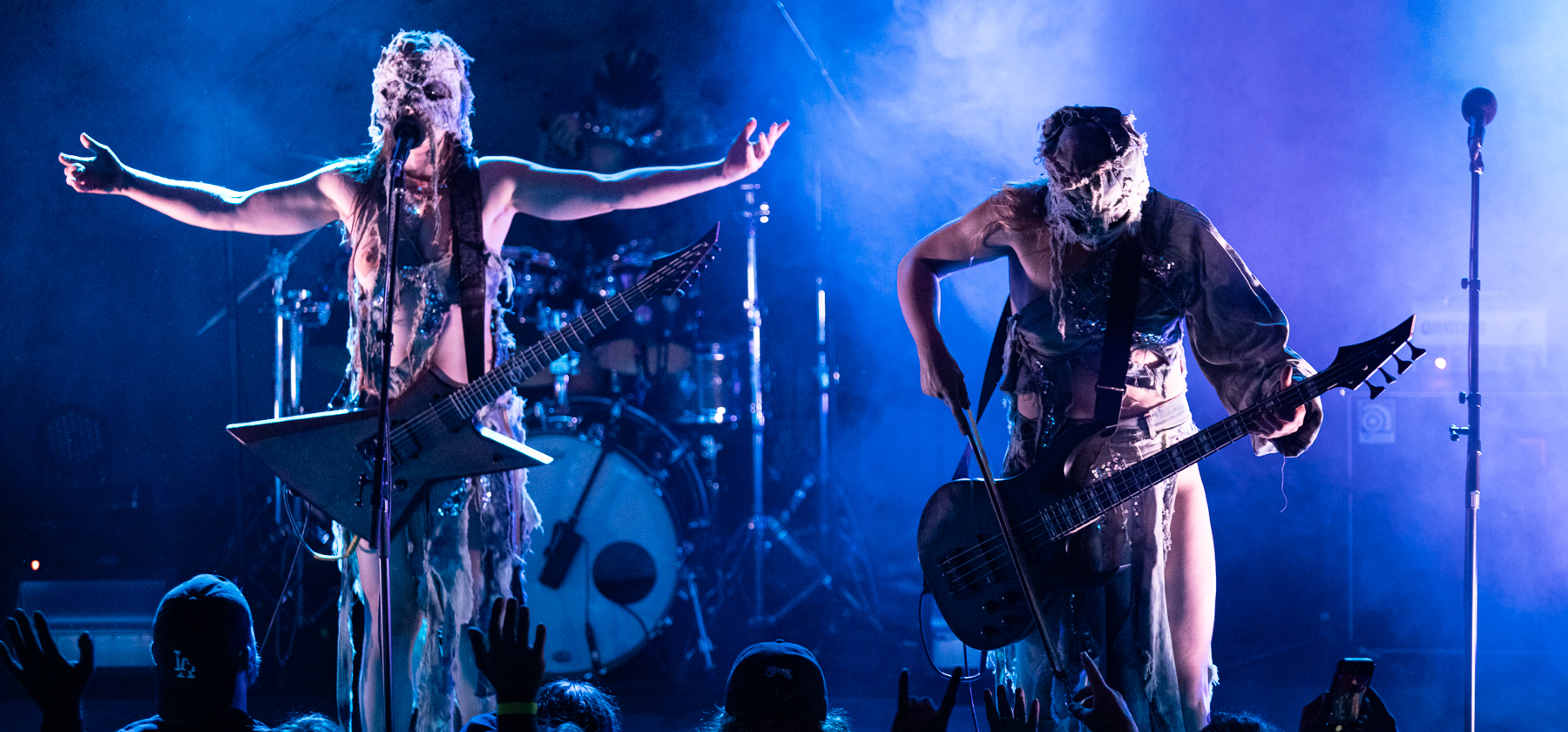
Witch Club Satan
Patriarchy
Cornerstone, Berkeley, CA
June 13, 2026
Photos and words by Geoffrey Smith II
When Norway’s Witch Club Satan launched their first North American tour, reports from early stops highlighted the sheer sensory overload of their performances. By the time the tour hit Cornerstone in Berkeley on June 13th, the band was actively processing their first taste of American crowds. Vocalist and guitarist Nikoline Spjelkavik noted in a recent interview that they found U.S. audiences “vibrant, loud, and less shy” than back home, specifically marveling at our active mosh pits. What I witnessed in Berkeley certainly backed this up.
The first thing I experienced on my way to this show was the literal layout of Cornerstone. The concert venue is attached to a busy gastropub, requiring you to walk past people ordering flights of IPAs and charcuterie boards before you enter the space. Arriving just-on-time, I was immediately pummeled by the Industrial assault of the opening duo, Patriarchy.
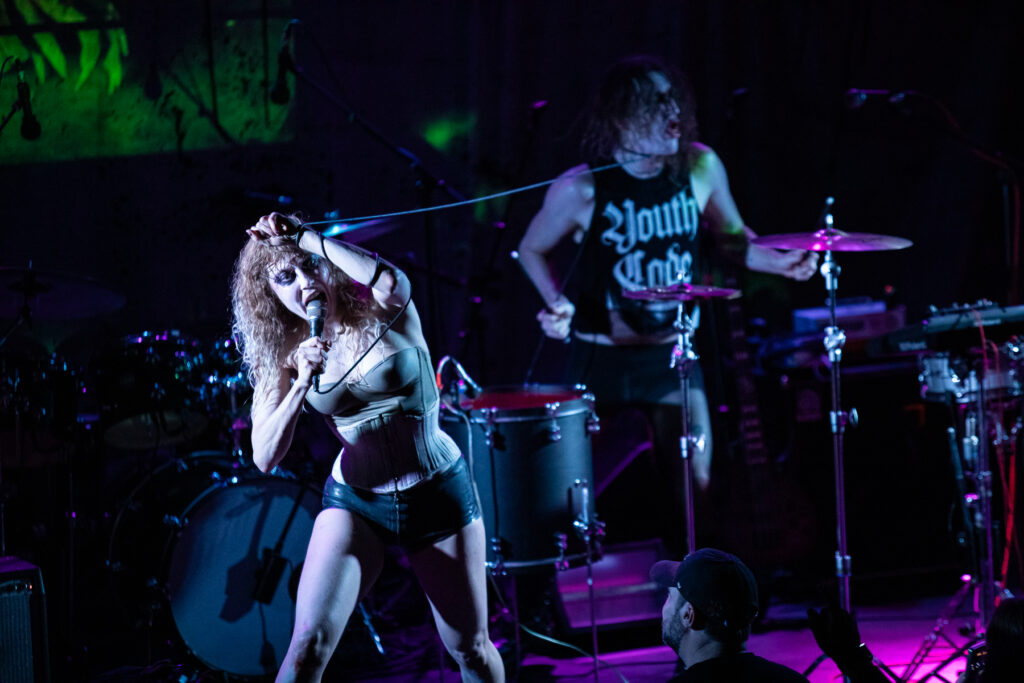
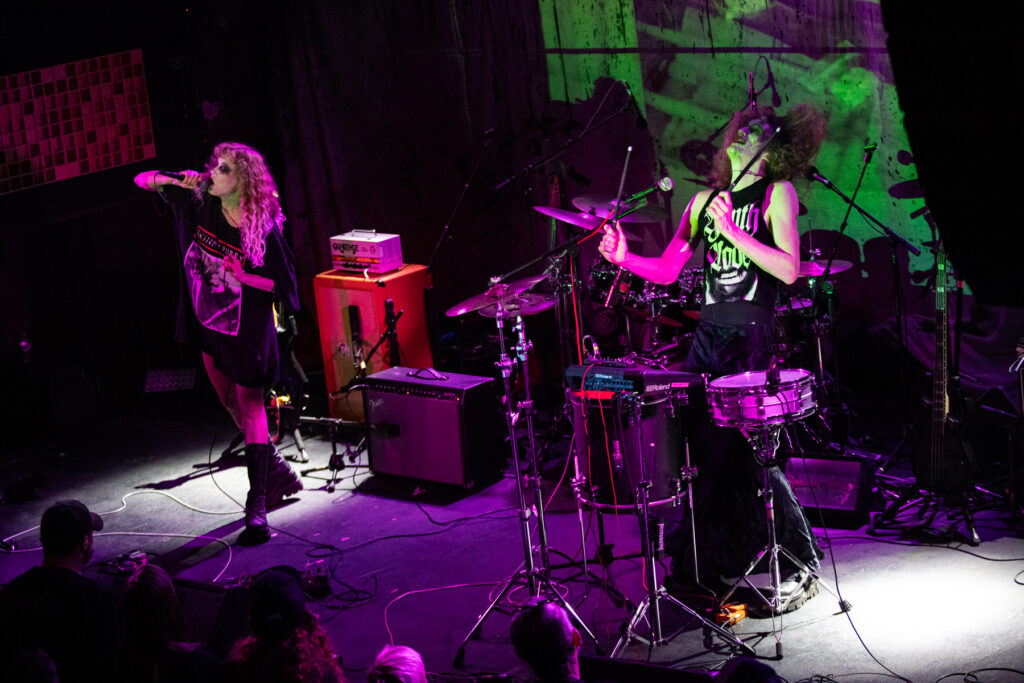
I’d seen them before at the last Substance Festival 2025 in San Francisco, and I knew I was in for a wild time. Composed of vocalist Actually Huizenga and drummer Andrew Means live (I’m unsure about the division of labor on the recorded side), Patriarchy turned their opening performance into an unpredictable and confrontational set built on raw, unsexy kink, frequently subverting power dynamics. At one point, Huizenga wrapped her microphone cord around Means’s neck, pulling it taut as she sang from across the stage. This put the masculine member of the band into a submissive role, though this dynamic inverted later when Means positioned a floor tom over her body as she lay on the stage floor and sang. Means also broke the boundary of the stage completely, scaling the wall of the venue’s stage toward the balcony. While the crowd seemed skeptical at first, the band won them over by the end of their set, with them constantly moving.
Following the opener, a survey of the venue revealed a demographic split: older or more conservative attendees filled up the balcony before the floor below. It was hard to tell if they were there to watch what they expected to be a theatrical show from a comfortable vantage point, or if they were veteran metal heads who earned their stripes in mosh pits but didn’t want to get injured before returning to the office on Monday. Down on the floor, a younger contingent seemed to claim the first few rows, a handful sporting corpse paint in emulation (or solidarity?) of the headlining trio.
When Witch Club Satan took the stage, the room was almost totally dark. An ambient, wind-like pre-recorded track with a low-end sub-bass rumble filled the space. Walking out in unison holding twin sticks of incense, the three members slowly wafted trails of smoke before crouching to hand the sticks to front-row audience members. The earthy, sweet scent was powerful enough to cut through the smell of stale battle jackets and hamburgers, reaching all the way to the balcony.
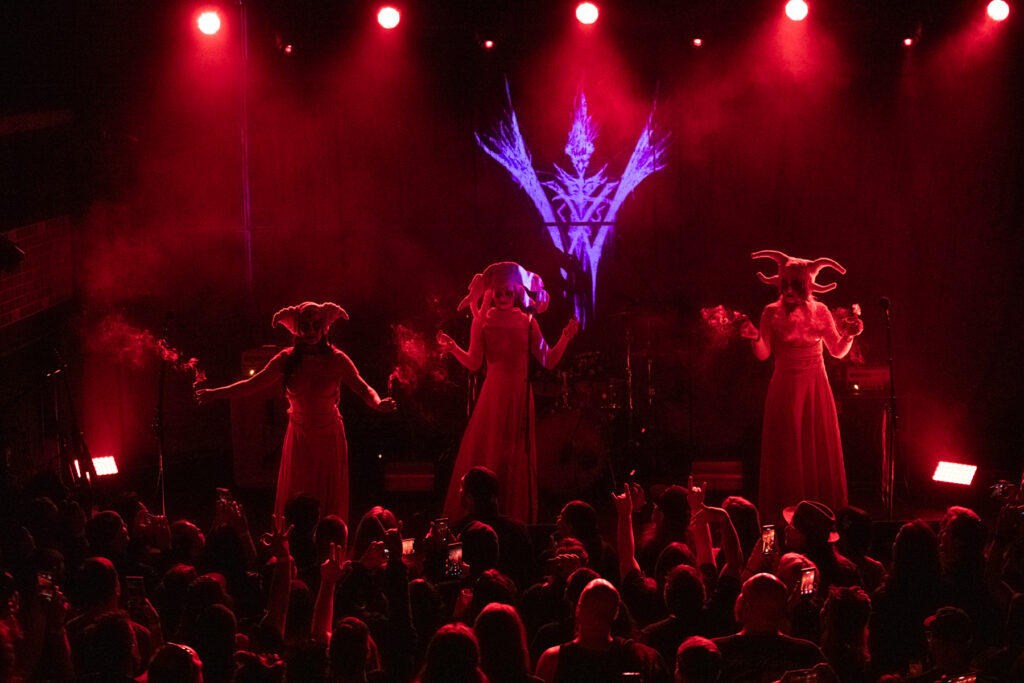
Vocalist/guitarist Nikoline Spjelkavik methodically stalked to the mic, bassist/vocalist Victoria Røising grabbed her bass, and drummer Johanna Holt Kleive took her throne. Frequent drum kicks began to coincide with blinding white strobes, revealing the first of several wardrobe configurations by the band: flowing white dresses topped with odd, horn-like headdresses made of a white, crocheted textile. Their breasts were intentionally exposed, with pasties covering their nipples, though the presentation was not intentionally sexual. It felt like cold, calculated aesthetic world-building.
If you went into this show hoping for traditional, old-school Norwegian black metal standards, they probably weren’t ‘brutal’ or technical enough, and the electronic embellishments probably made you wince. The trio feels less like a grim metal band and more like Norwegian theater kids piloting an extreme music project, splitting the energy between intense stage displays and moving, sonic landscapes. They routinely treated their instruments more like weapons of friction than tools for technical precision, creating a thick wall of sound that made you wonder how much of the instrumentation was live versus carried by a playback mix. No hate either way; being a fan of all forms of electronic/acoustic music hybrid genres, I’m on board for whatever makes a great live show experience.
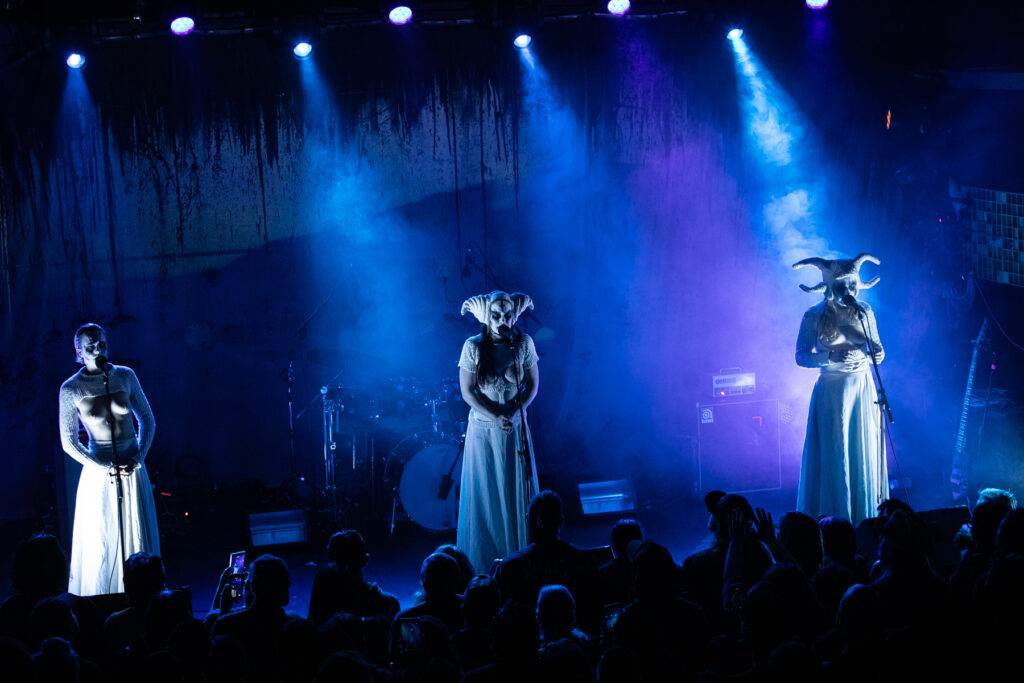
“Welcome to the founding meeting. Welcome to the Coven.” Kleive announced in a dramatic, screechy growl. “We need you to know, this is not a safe space. This is a cold and transformative space. This is a space for us to grieve and rage in. This is not a show. It is a ritual.”
This might not be verbatim, and there were likely some ESL artifacts, but the dramatic intent landed perfectly with the crowd. For a moment, I was worried it would segue into some kind of anti-PC monologue, but thankfully that wasn’t the case. Funnily, it did lead right into the track “Hysteria”, which takes shots at people eating in their beds and growing fat, providing another amusing counterpoint to a venue serving hamburgers in a nation with high obesity rates when compared to Scandinavian territories (though the gap is reportedly closing).
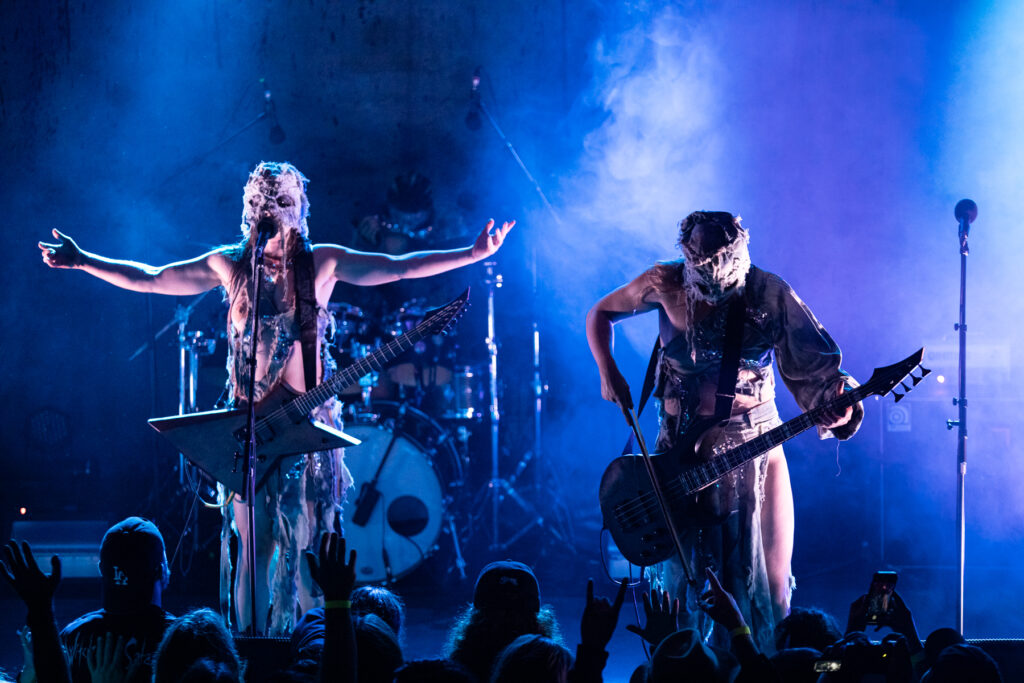
Musically, the track relied on a grooving bassline, lots of low end, and heavy floor toms. Spjelkavik managed to command the crowd into a militant clap-along during the tracks midway, before the song transitioned into fast blast beats and lots of shredding. For just the second song of the set, the Berkeley crowd was remarkably locked in and moving.
For the second act of the set, a rumbling, haunting sound accompanied the band’s return to the stage as they walked out wearing long, stringy black wigs that looked straight out of a Japanese horror film. They were near-naked, clad in flesh-toned body stockings that doubled down on the unsettling, non-sexual horror film aesthetic. Røising approached the front of the stage to let out a monstrous growl, answered by an animalistic shriek from Spjelkavik , while an audience member held up two hands with their forefingers and thumbs forming a “W” sign in response. Kleive spit fake blood, which she had been letting drip from her mouth, directly into the audience. From there, the two performed in unison over a chugging guitar line that gave way to conventional black metal blast beats, backed by a thick wall of low-end noise. The floor responded immediately, with a mosh pit breaking out near the front.
This uptick in movement and aggressiveness led to a moment of friction when a (presumably) metal show newcomer began complaining about getting pushed. Another person loudly retorted, “Shut up you nerd!” in a comically soft and dated insult that made me chuckle. Noticing the commotion, Spjelkavik paused to address the floor, explicitly pointing out that they love it when people mosh out their shows, and the area to the middle-front of the stage is widely regarded as a moshing zone, and anyone not wanting to participate should move. I’m honestly so used to bands coddling the audience that I was kind of surprised, but pleased, that this was their response.
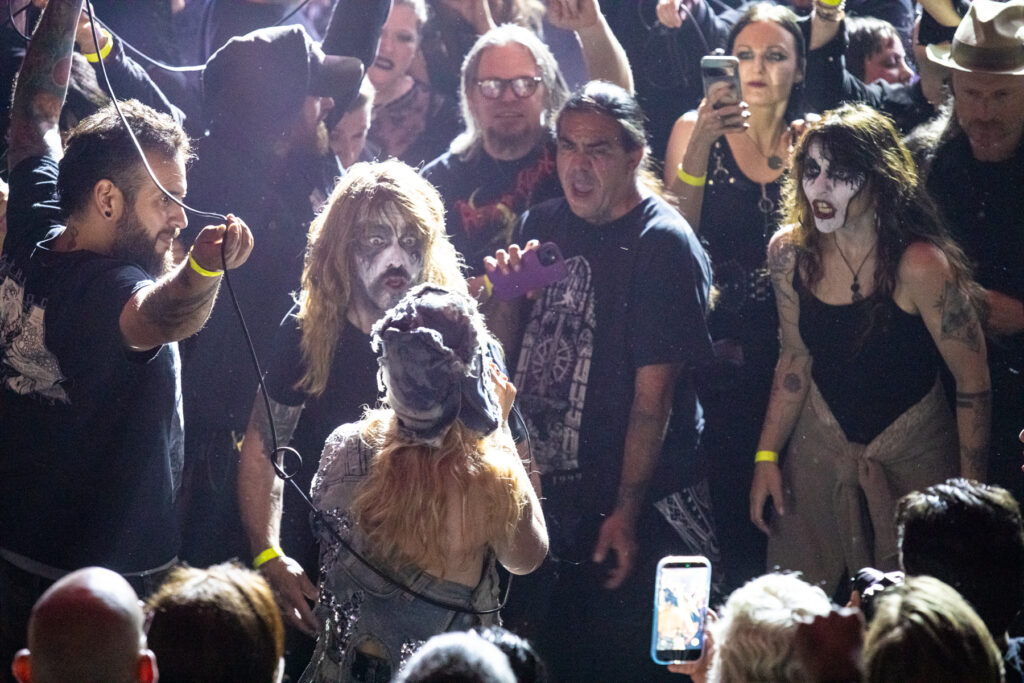
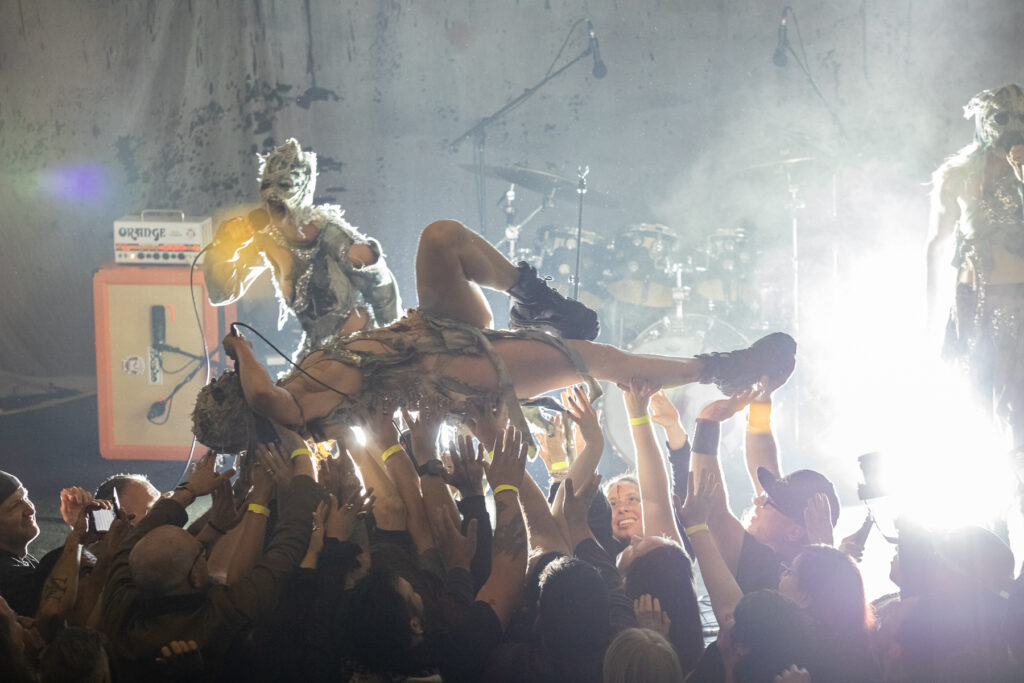
The third act brought another visual shift. The band returned wearing garb and masks that appeared to be made of shredded, glittering, denim jeans. Spjelkavik stepped directly off the stage to lightly mosh, screaming the lyrics to “Wildflower” in the faces of audience members, closely tailed by a tech or stagehand frantically managing the slack of her mic cord. Most people smiled in response and those that knew the lyrics (usually the ones wearing corpse paint) sang them back. It was remarkably wholesome and fun. Then the track descended into a mid-tempo, grooving guitar, and heavy tom rhythm that had the crowd rocking back and forth, just under mandatory headbanging speed.
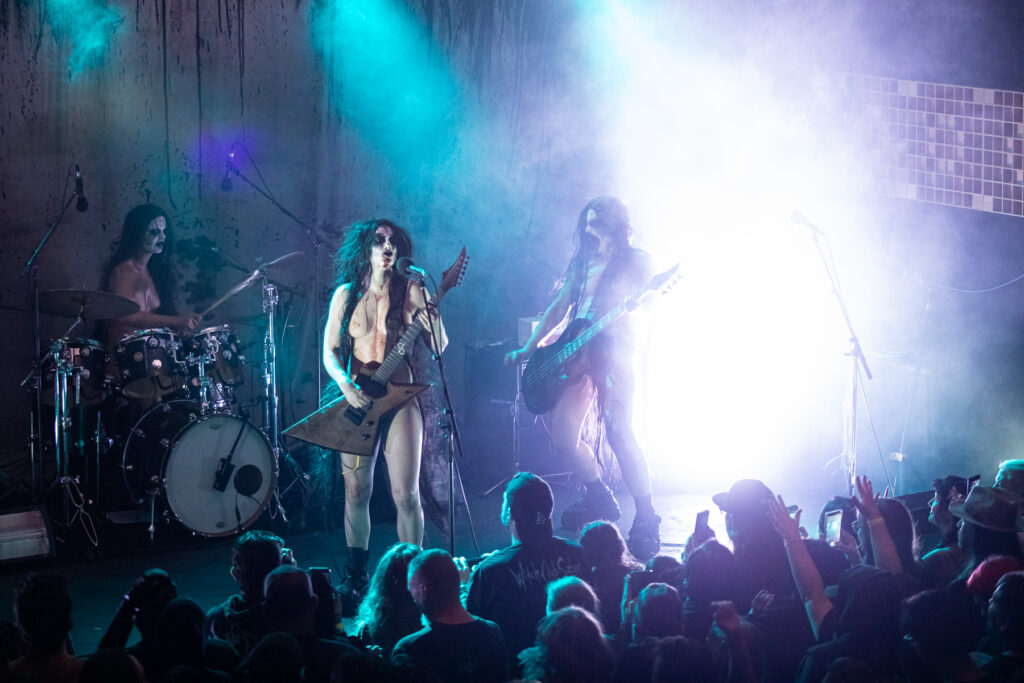
This segued into “Fresh Blood, Fresh Pussy,” which was the most consistently intense and heavy track of the night. The band and the audience peaked here, filling the room with a constant wall of noise. Røising’s drumming was undeniably live, and you could physically feel the punch of the toms, even if the cymbal work felt a bit sloppy amidst the chaos.
The band then informed the room that it was their last chance to dance, launching into the electronic grooves of “Witchcraft Techno,” causing everyone to dance with its heavy and consistent beat. In the middle of the track, a band member launched herself into a crowd surf while delivering vocals at the same time. Either the crowd density on the floor wasn’t quite thick enough to sustain her, or people were just squeamish about holding up a mostly naked woman, so she sank into the crowd, made one more attempt and made her way back to the stage. It made for an interesting spectacle and though it seems to be a scripted part of the band’s performance, it still felt sincere.
With just a single full-length record under their belt, Witch Club Satan’s set concluded with “Solace Sisters.” After the high energy and catchy electronic rhythms of the preceding tracks, this slower and more atmospheric piece felt like a bit of a downshift in momentum. When the band finally walked off the stage, the lights went up and a lot of the crowd seemed to be in a daze. Many of us stood around for a bit, both expecting and hoping for an encore.
And I want to note the general positive quality of the crowd. There were no grumpy black metal gatekeepers standing around with their arms crossed in a huff, because the subversion of the genre is baked right into the band’s almost comical name. Nobody was paying $40 to come out and intentionally have a bad time. Instead, the folks shuffling out the door were a mix of old music nerds who pull records from every genre bin at the store, and young music nerds who stream weird, niche stuff. And they got exactly what they came for: a performance that pushed the boundaries of live theater and extreme metal, creating something entirely different as a result of their union.
